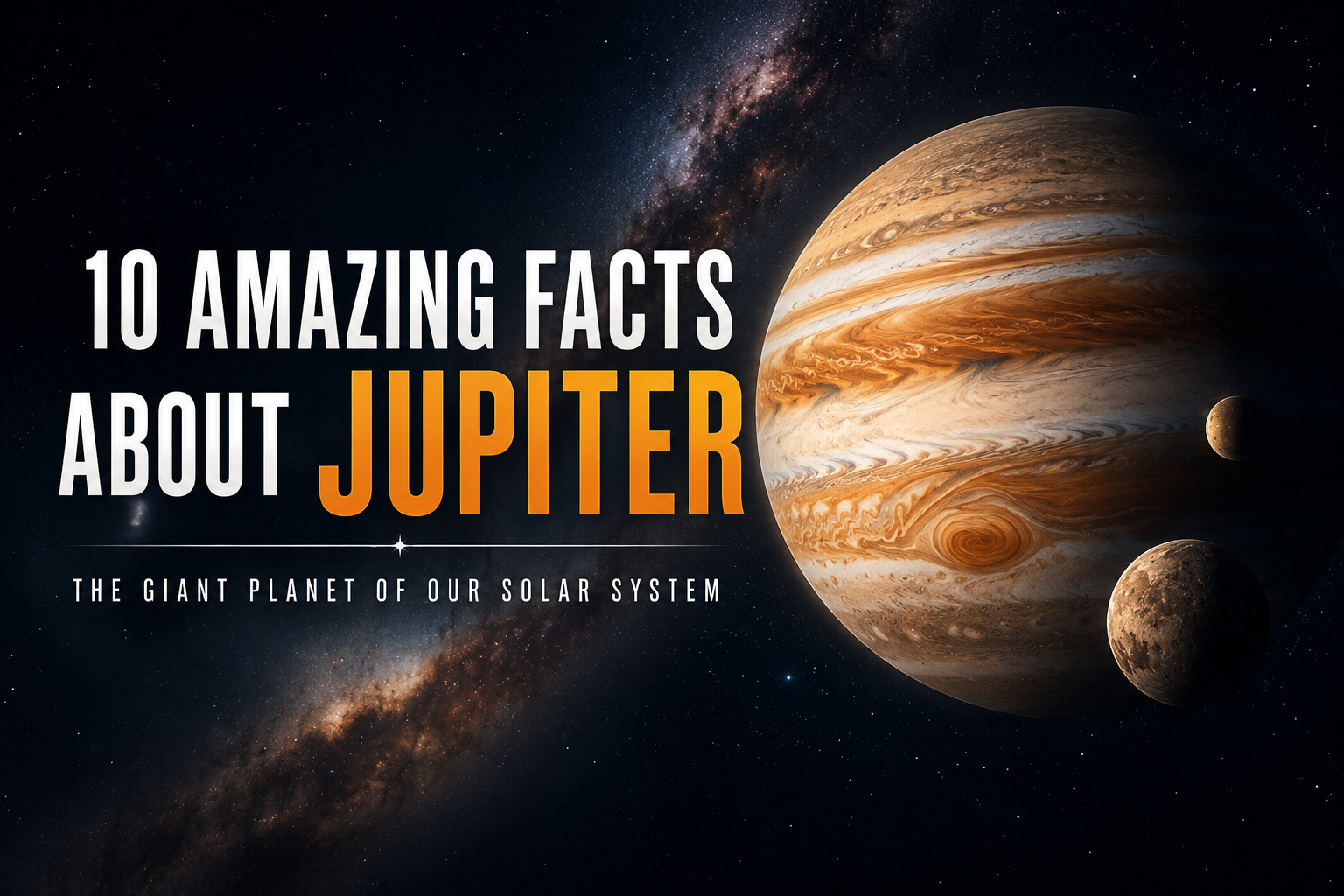
10 Amazing Facts About Jupiter You Need to Know
Introduction
Jupiter is the largest planet in our Solar System—and it is far more fascinating than its enormous size suggests. From its gigantic storms to its dozens of moons, this gas giant is one of the most extraordinary worlds we know.
Located about 778 million kilometers from the Sun on average, Jupiter has been observed by astronomers for thousands of years. Modern spacecraft have revealed a world of powerful winds, extreme pressure, intense magnetic fields, and mysterious atmospheric phenomena.
Here are 10 amazing facts about Jupiter that reveal just how extraordinary this giant planet really is.
- Jupiter Is the Largest Planet in the Solar System
Jupiter is enormous.
Its diameter is about 140,000 kilometers, making it roughly 11 times wider than Earth. By volume, around 1,300 Earths could fit inside Jupiter.
Despite its enormous size, Jupiter is relatively light for a planet of its volume because it is composed mainly of hydrogen and helium.
Its mass is about 318 times that of Earth, making Jupiter more massive than all the other planets in our Solar System combined.
- A Day on Jupiter Lasts Only About 10 Hours
Jupiter rotates incredibly fast.
One complete rotation takes approximately 9 hours and 56 minutes, making it the planet with the shortest day in the Solar System.
This rapid rotation also affects Jupiter’s shape. The planet bulges noticeably around its equator and is flattened slightly at its poles.
Imagine watching the Sun rise and set on a world where an entire day lasts less than 10 hours.
- Jupiter Has the Great Red Spot
One of Jupiter’s most famous features is the Great Red Spot, a gigantic storm in the planet’s atmosphere.
It is a persistent anticyclonic storm that has been observed for centuries. The storm is much wider than Earth, although its size has changed significantly over time.
Winds around the storm can reach hundreds of kilometers per hour.
Even after centuries of observation, scientists are still studying why this enormous storm has lasted for so long.
- Jupiter Does Not Have a Solid Surface
Unlike Earth, Jupiter does not have a solid surface that you could stand on.
It is a gas giant, composed primarily of hydrogen and helium. As you descend into its atmosphere, pressure and temperature increase dramatically.
Eventually, the hydrogen becomes compressed into an exotic state known as metallic hydrogen, which may contribute to Jupiter’s powerful magnetic field.
So if you somehow tried to land on Jupiter, there would be no solid ground waiting beneath the clouds.
- Jupiter Has an Enormous Magnetic Field
Jupiter possesses the strongest planetary magnetic field in the Solar System.
Its magnetic environment is so powerful that it traps charged particles and creates an enormous magnetosphere extending millions of kilometers into space.
This magnetic field also produces spectacular auroras around Jupiter’s poles.
Unlike Earth’s auroras, Jupiter’s auroras are strongly influenced by its magnetic field and interactions with its moons and surrounding plasma environment.
- Jupiter Has a Huge Family of Moons
Jupiter is surrounded by a remarkable collection of natural satellites.
Among the most famous are the four Galilean moons:
- Io — the most volcanically active world known
- Europa — an icy moon with a subsurface ocean
- Ganymede — the largest moon in the Solar System
- Callisto — a heavily cratered ancient world
These four moons were first observed through a telescope by Galileo Galilei in 1610.
Each of them is a world with its own fascinating geology and history.
- Ganymede Is Bigger Than Mercury
Jupiter’s moon Ganymede is the largest moon in the Solar System.
It is even larger in diameter than Mercury, although Mercury has greater mass.
Ganymede is especially interesting because it has its own intrinsic magnetic field—the only known moon to have one.
Scientists also have strong evidence that Ganymede contains a large underground saltwater ocean beneath its icy surface.
- Europa May Hide a Vast Ocean Beneath Its Ice
Europa is one of the most intriguing places in the Solar System.
Its surface is covered by a thick layer of water ice, but observations indicate that a global ocean of liquid water may exist beneath that ice.
Scientists are particularly interested in Europa because liquid water, chemistry, and energy sources could potentially provide environments suitable for life.
NASA’s Europa Clipper mission is studying Europa in detail to investigate its habitability.
That does not mean life has been discovered there. Instead, Europa is considered one of the most promising places to search for potentially habitable environments beyond Earth.
- Jupiter Has Rings Too
When we think of planetary rings, Saturn usually comes to mind.
But Jupiter also has a ring system.
Jupiter’s rings are much fainter and darker than Saturn’s, making them difficult to observe from Earth with ordinary telescopes.
They are composed largely of tiny dust particles, much of which is thought to come from impacts on Jupiter’s small inner moons.
So yes—Jupiter has rings, too.
- Jupiter Is Almost a Star—but Not Quite
Jupiter is sometimes described as a “failed star,” but that phrase can be misleading.
Jupiter and the Sun are both composed mainly of hydrogen and helium, but Jupiter simply does not have enough mass to start the nuclear fusion that powers a star.
To become a true star, an object needs to be vastly more massive.
Jupiter is enormous compared with Earth, but it is still only about one-thousandth the mass of the Sun.
So Jupiter isn’t a failed star—it is a gas giant planet that formed from the same primordial material that existed in the early Solar System.
Why Jupiter Matters
Jupiter isn’t just a giant planet floating far away from Earth. It is an important laboratory for understanding how planets form and evolve.
Its enormous atmosphere, powerful magnetic field, complex moon system, and extreme interior conditions give scientists an opportunity to study planetary physics on a scale unlike anything found on Earth.
And its moons may hold some of the biggest clues in our search for potentially habitable environments beyond our planet.
Final Thought
Jupiter reminds us that our Solar System is far more dynamic and mysterious than it may appear from Earth.
A planet nearly 1,300 Earths could fit inside, a storm larger than our planet has persisted for centuries, and an icy moon may conceal an enormous ocean beneath its frozen surface.
The more we explore Jupiter, the more questions we discover.
The Solar System is our cosmic neighborhood—and Jupiter may be its most fascinating giant.
🔭 Keep Exploring
Discover more fascinating stories about planets, stars, galaxies, black holes, space missions, and the mysteries of the universe with The Cosmos Journey.