The Universe Is Hiding Something From Us
Introduction
We look into the night sky and see stars, galaxies, and distant worlds scattered across an apparently endless darkness.But what if everything we can see is only a tiny fraction of what actually exists?The observable universe is estimated to contain hundreds of billions of galaxies, yet even with our most powerful telescopes, we can observe only the portion of the universe whose light has had enough time to reach us.Beyond that cosmic horizon lies something we cannot directly see.And that is where the mystery begins.
🌌 1. What Exists Beyond the Observable Universe?
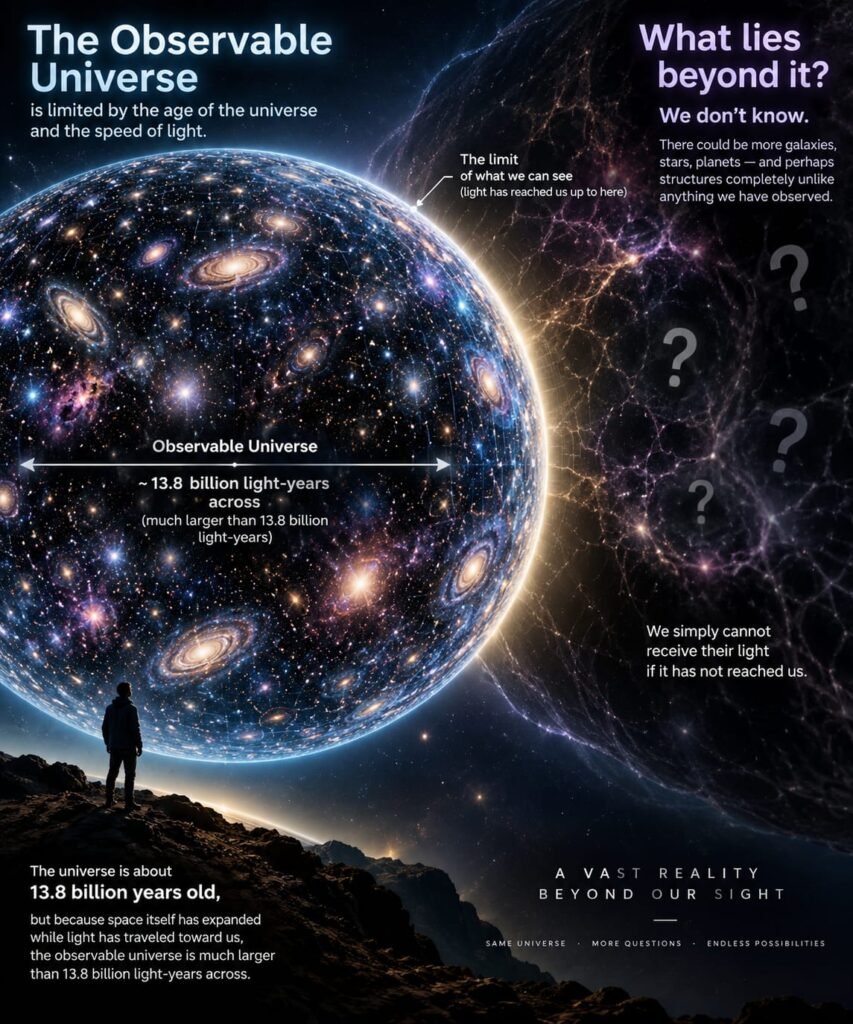
The observable universe is limited by the age of the universe and the speed of light. The universe is about 13.8 billion years old, but because space itself has expanded while light has traveled toward us, the observable universe is much larger than 13.8 billion light-years across. So what lies beyond it? We don't know. There could be more galaxies, stars, planets—and perhaps structures completely unlike anything we have observed. We simply cannot receive their light if it has not reached us.
🕳️ 2. Dark Matter: The Invisible Architecture
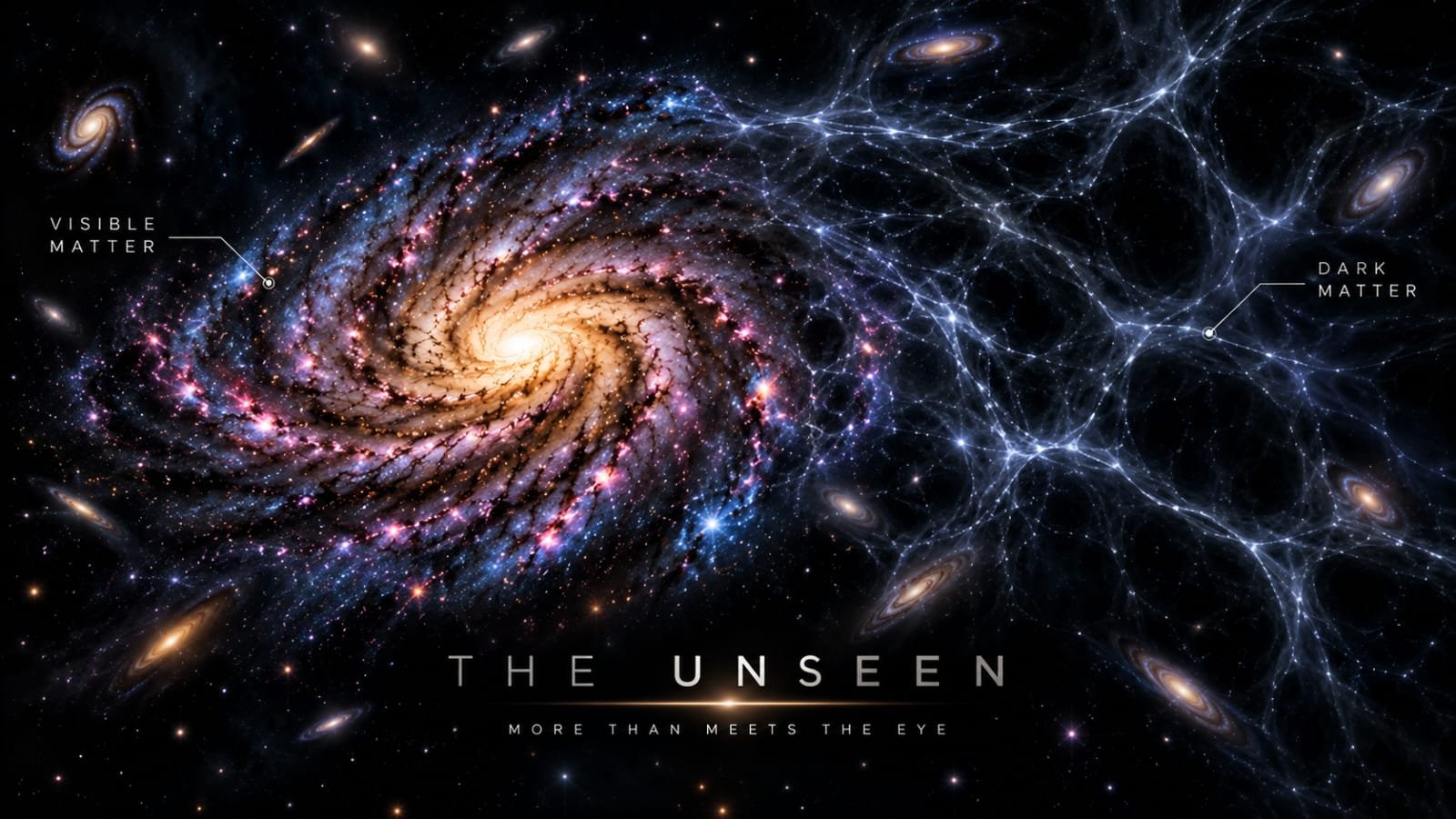
Galaxies rotate as though they contain far more mass than we can see. Stars and gas alone cannot fully explain their gravitational behavior. Scientists call the unseen component dark matter. It does not appear to absorb, emit, or reflect light in the ordinary way. Yet its gravitational influence appears throughout the cosmos. We know something is affecting matter. But we still don't know exactly what that something is.
3. Dark Energy: The Even Bigger Mystery
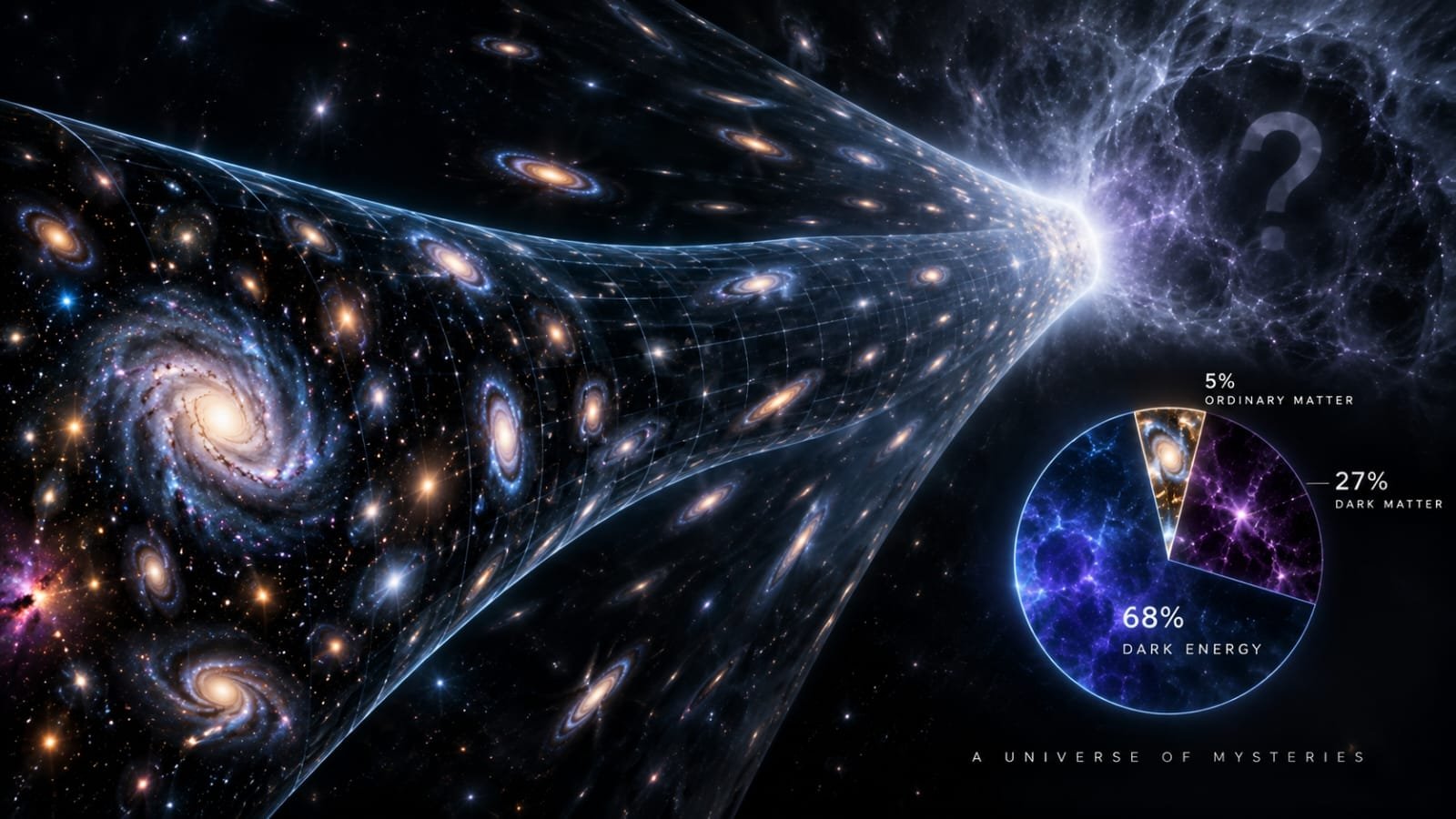
Here is something even stranger. The expansion of the universe is accelerating. Scientists use the term dark energy for whatever is responsible for this observed acceleration. According to the standard cosmological model, dark energy makes up roughly 68% of the universe, while dark matter accounts for about 27%. Ordinary matter—the stars, planets, galaxies, and everything we can directly observe—is only a small fraction. That means most of the universe is made of things whose fundamental nature remains unknown.
🌀 4. What Happens Inside a Black Hole?
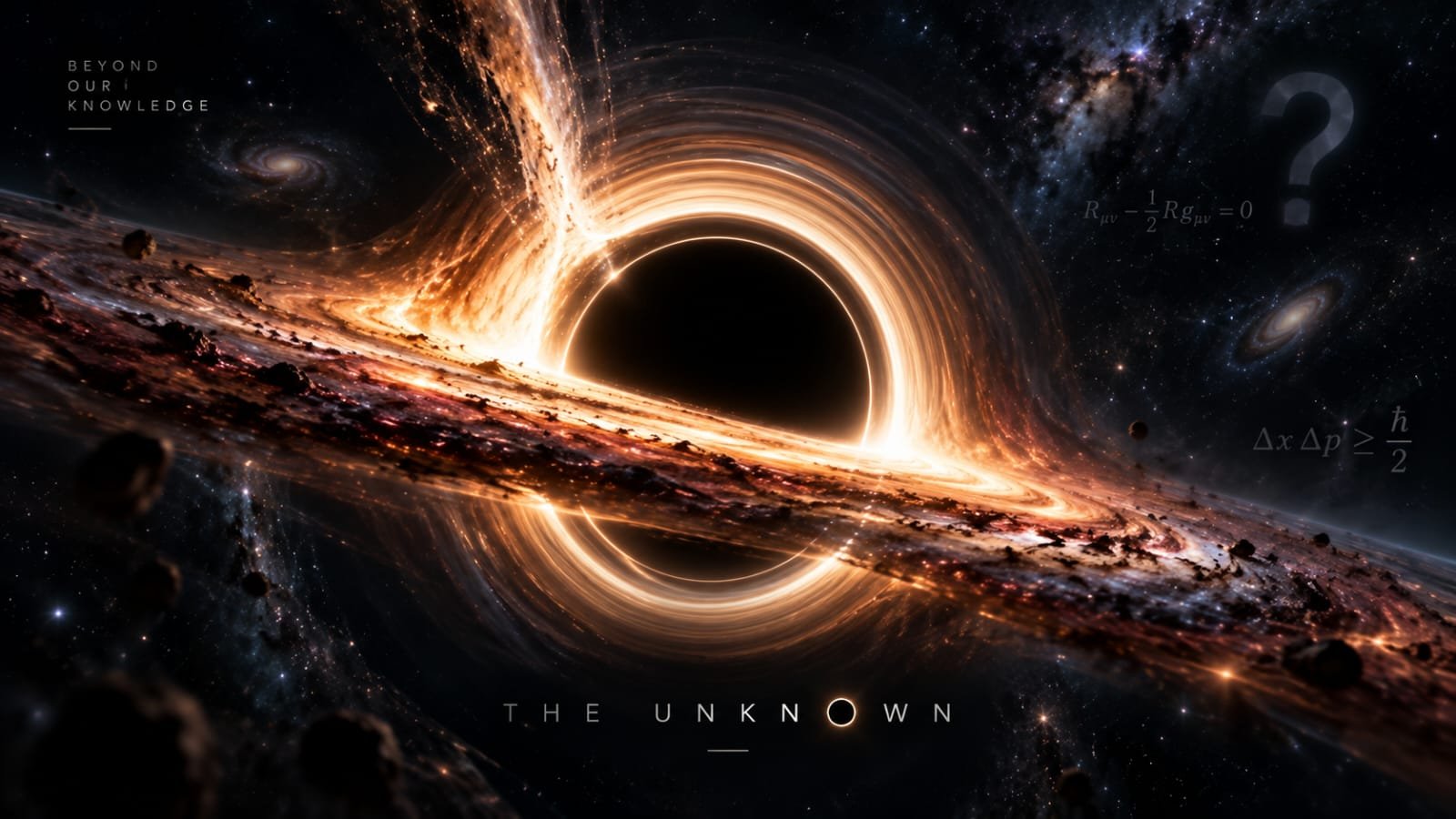
A black hole has gravity so strong that beyond its event horizon, light cannot escape. But what happens deep inside? General relativity predicts that matter collapses toward a region where our current equations break down—the famous singularity. However, physicists do not yet have a complete theory combining gravity with quantum mechanics. So the true nature of a black hole's interior remains one of the greatest unanswered questions in physics.
⏳ 5. Did Time Always Exist?
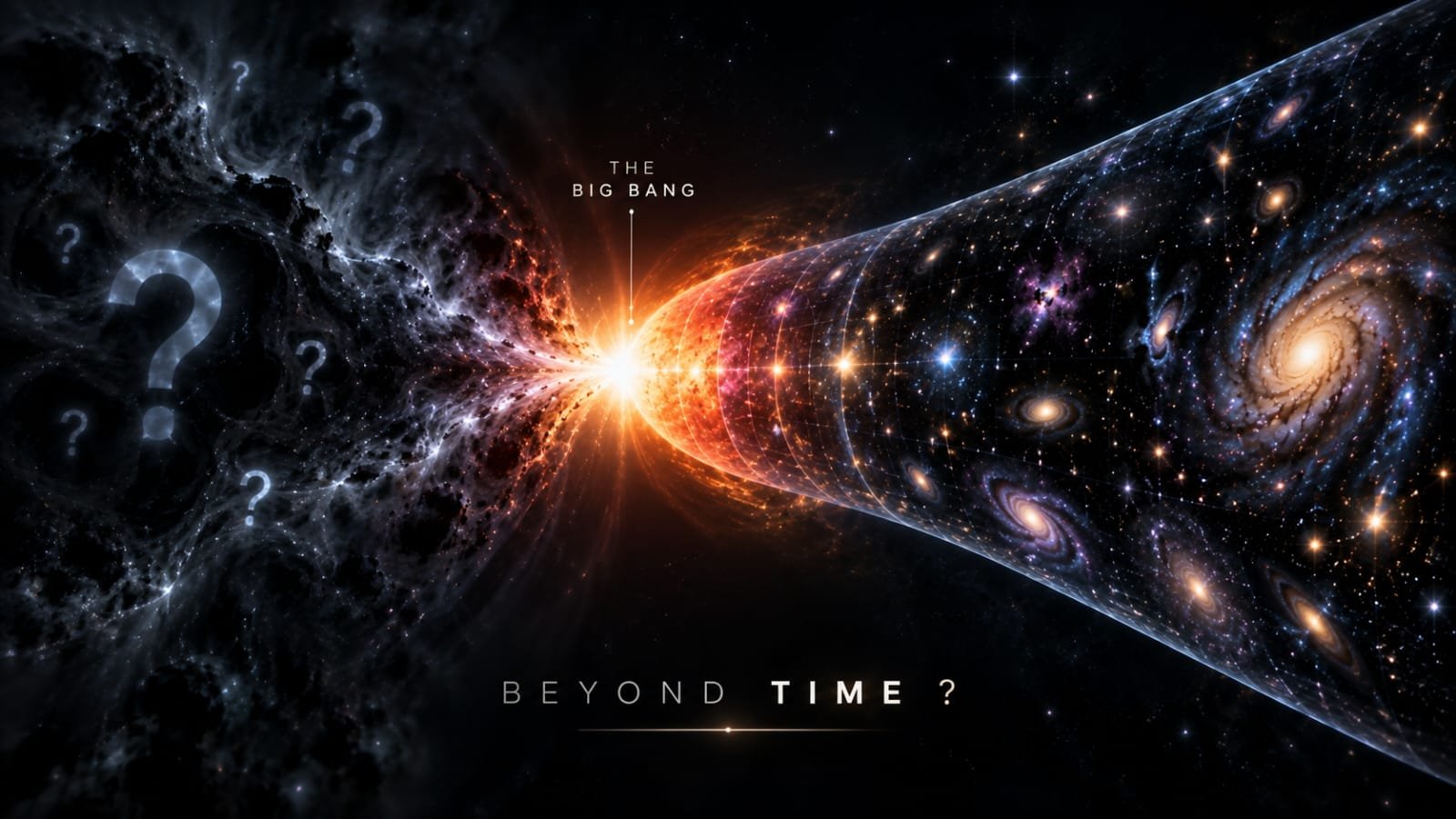
Our best-tested cosmological models trace the observable universe back to an extremely hot, dense early state. But asking what happened before the Big Bang may be more complicated than it sounds. Time itself is part of spacetime. If time as we understand it emerged with the early universe, the word "before" may not even have its usual meaning. We don't yet know.
👽 6. Are We Alone?
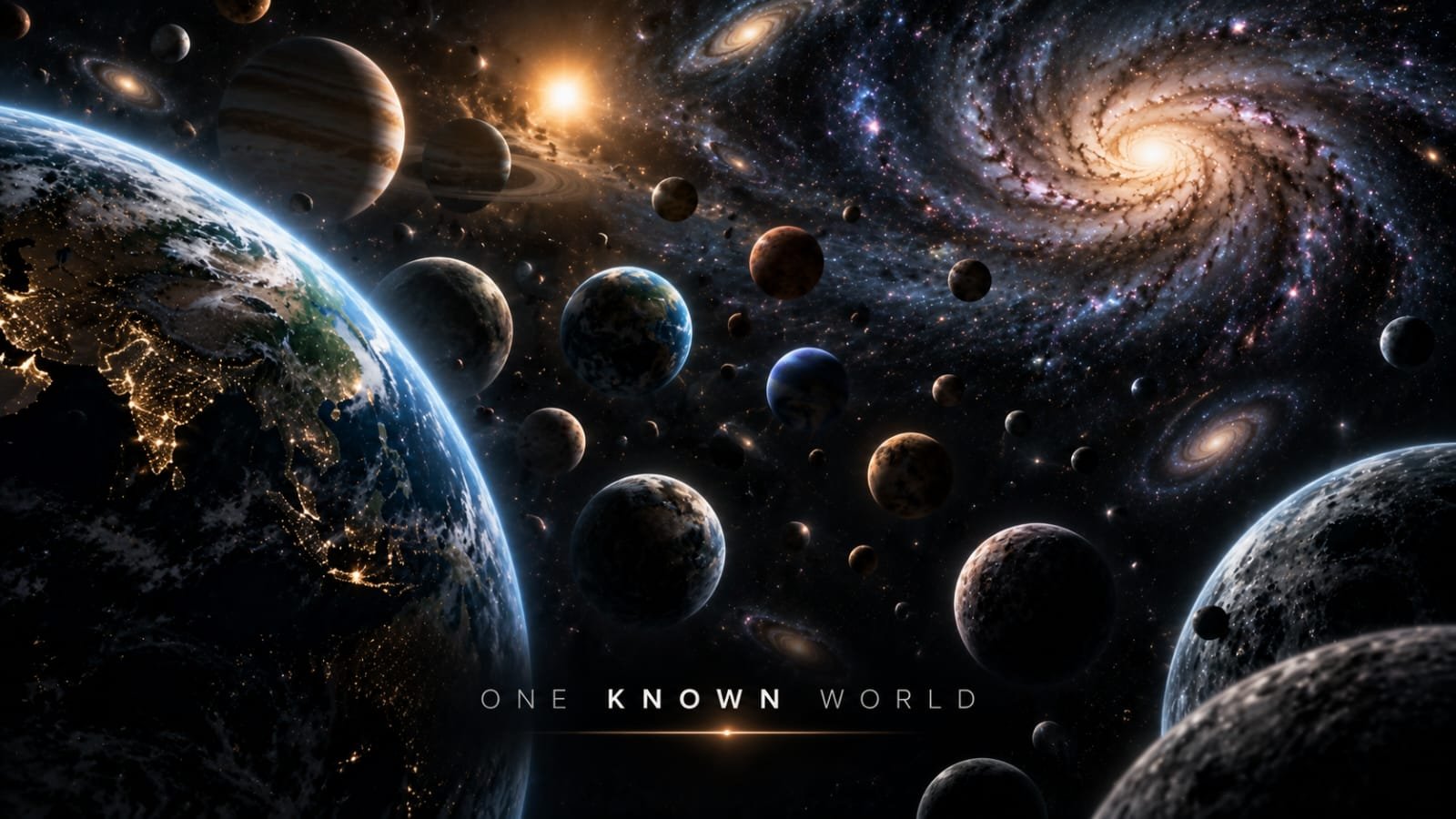
There are enormous numbers of stars and planets in the universe. Some planets orbit within regions where temperatures could potentially allow liquid water on their surfaces. Yet despite decades of searching, we have not confirmed extraterrestrial life. The universe could be filled with life—or Earth could be extraordinarily unusual. For now, we have only one confirmed example of life: Earth.
🔭 7. The Most Mysterious Thing May Be the Universe Itself
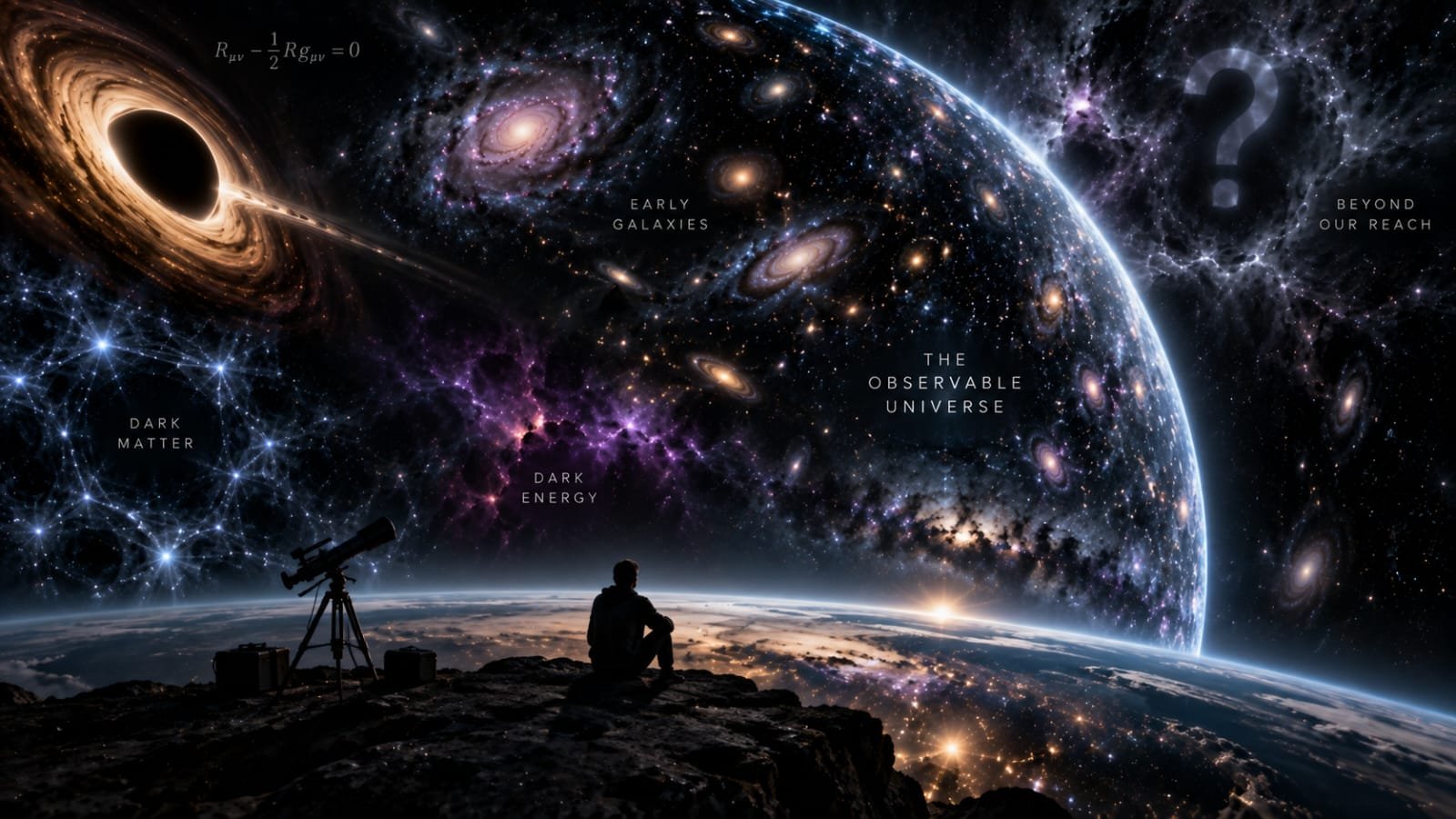
Every telescope reveals something unexpected. Ancient galaxies challenge our understanding of cosmic evolution. Dark matter remains unidentified. Dark energy remains unexplained. Black holes push physics to its limits. And beyond the observable universe lies a region we may never be able to directly observe. Perhaps the most fascinating fact about the cosmos is not how much we know. It's how much remains unknown. When you look at the stars tonight, remember: You are not looking at the universe as a whole. You are looking at the small portion of reality that light has allowed us to see. And somewhere beyond that cosmic horizon... there may be mysteries we haven't even imagined yet.